
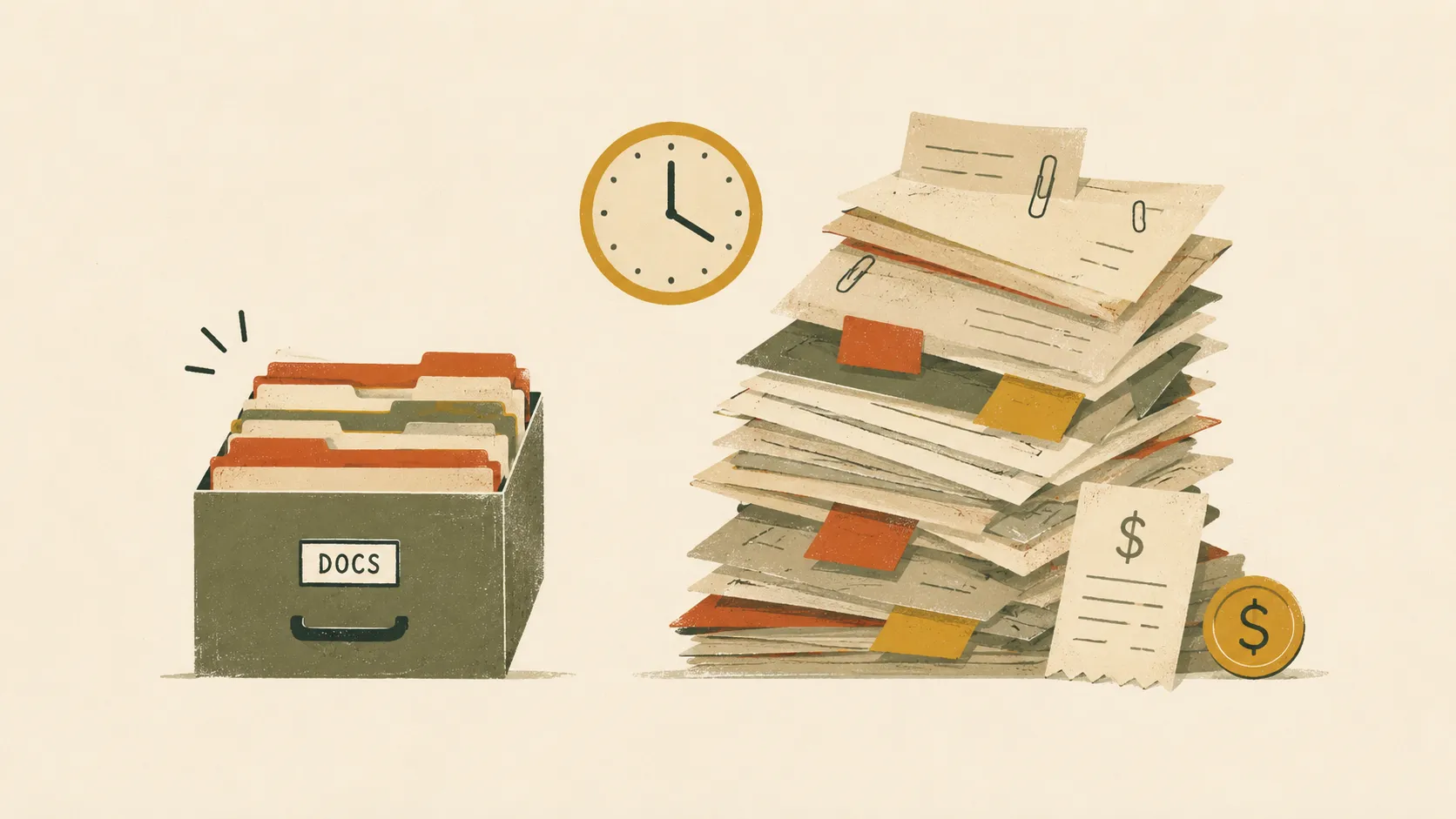
Outdated documentation rarely causes a dramatic, single failure. It works more like a tax — a small, constant drag on everything the team does, paid in confused new hires, slower incident response, and the quiet moment when an engineer decides the docs aren’t worth reading. Because the cost is diffuse, it almost never gets prioritised. That’s exactly why it persists.
Why docs rot — structurally, not lazily
It’s tempting to blame stale docs on discipline. The real cause is structural: code changes continuously, and docs are updated manually as a separate step. Every commit is an opportunity for the docs to fall behind. Every deadline is a reason the update gets deferred. Multiply across a team and drift isn’t an accident — it’s the default state of any documentation that depends on someone remembering to update it.
What stale docs actually cost
Onboarding time
A new engineer reads the docs, builds a mental model, then discovers — usually mid-task — that the model is wrong. Now they have to re-learn from the code, and worse, they’ve lost trust in the docs for everything else. The documentation that was supposed to speed onboarding actively slowed it.
Incident response
During an incident, responders reach for runbooks and architecture docs under time pressure. A stale runbook — referencing a service that was renamed, a dashboard that moved — costs minutes exactly when minutes are most expensive. Stale architecture docs send investigation down the wrong path.
Trust, the compounding cost
This is the one that compounds. The first time a doc burns an engineer, they discount it. After the second, they stop reading docs and go straight to the source. At that point every hour the team spent writing documentation is wasted — the docs exist but nobody uses them. Stale docs don’t just fail to help; they destroy the value of the docs that are still correct.
Why “just update the docs” fails
Every team has tried the obvious fix: a culture of updating docs, a checklist, a Friday docs day. These help at the margin and then erode, because they fight the structural problem with willpower. Willpower loses to deadlines every time. The interventions that actually hold are the ones that change the structure:
- Generate what can be generated. Endpoints, schemas, module maps, and diagrams can be derived from code. If they regenerate on every commit, they can’t drift — no discipline required.
- Enforce the rest in review. For conceptual docs that need a human, make the doc update part of the PR that changes the behaviour. The reviewer is the enforcement mechanism.
- Date everything. A visible “last updated” and commit reference lets readers judge freshness instead of assuming. It also makes drift visible, which is the first step to fixing it.
Make drift visible
You can’t fix what you can’t see. The teams that stay ahead of drift treat documentation like code: versioned, diffable, regenerated on a schedule or on every merge. When a scan runs on each commit and the docs update with it, “is this current?” stops being a question — the docs reflect main by construction.
The fix that scales
The reference layer is where drift does the most damage and where automation is most achievable. VizRepo scans your repository and regenerates the endpoint, schema, and architecture docs on every commit, syncing them to Notion, Confluence, or your Git wiki. The docs track the code because they’re produced from it — drift isn’t managed, it’s designed out.
Next: how to keep documentation up to date walks through the concrete workflow, and software documentation best practices covers what to document in the first place.