
Always up-to-date
Docs update automatically when code changes. No more stale documentation.


For product engineering teams
Docs update automatically when code changes. No more stale documentation.
New engineers get productive faster with clear, structured, and searchable docs.
Capture architecture, flows, and business logic before it lives in someone's head.
Auto-generated diagrams and dependency maps reveal your system architecture.
Stop writing docs manually. Focus on building, not documenting.
Squad reorg or contractor wrap-up - the docs already exist, structured and current.
How it works
Connect GitHub, GitLab, or Bitbucket.
We analyze your code, structure, and dependencies.
AI creates clear docs, diagrams, and references.
Push to Notion, Confluence, or your internal wiki.
What you get
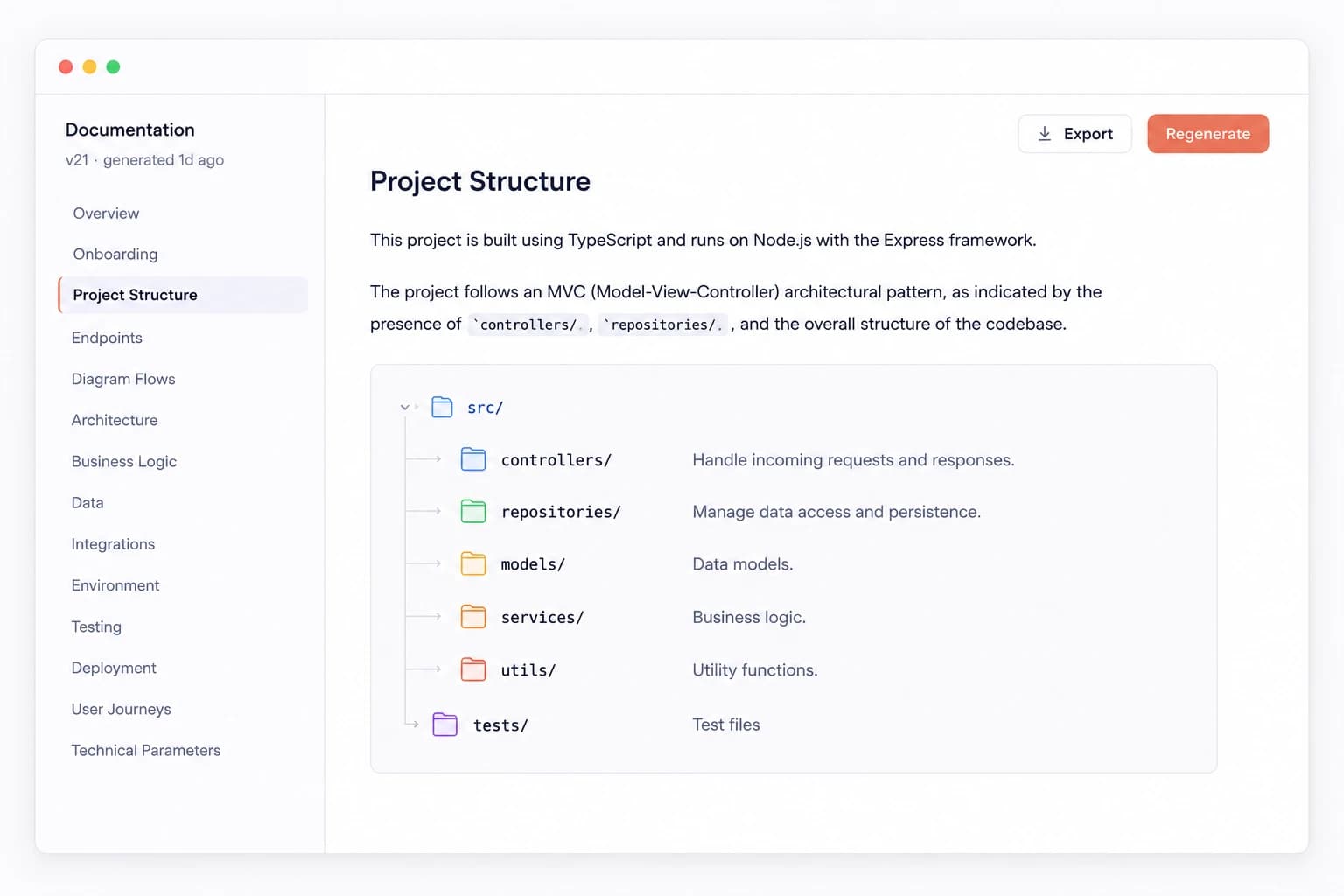
For every endpoint an AI agent reads the handler and everything it calls, then records what it does in plain language. Every file it cites is checked to exist in your repository. This is a real, shortened excerpt of VizRepo documenting its own backend.
/api/v1/auth/meLets a logged-in user permanently delete their own account, wiping every project they own and its related data, their team seats, and their Firebase identity.
401 | Missing or invalid bearer token |
404 | No user record for the authenticated caller |
src/common/middleware/auth.middleware.tssrc/modules/auth/auth.service.tssrc/modules/project/project.service.tssrc/modules/account-member/account-member.repository.tssrc/modules/auth/auth.service.tssrc/modules/auth/auth.controller.tsproject | delete | the project document itself |
endpoint | delete | all endpoints of each owned project |
accountMember | delete | delete-many by ownerId = user id |
user | delete | the user document by id |
External services: Firebase Authentication - delete the user's identity so they can no longer sign in.
Also generated per project: business logic overview, data-access matrix (which endpoint touches which table), user journeys, flow and sequence diagrams, onboarding, architecture and deployment sections.
Why it matters
AST-parsed, not AI-guessed. Endpoints, schemas, and call graphs come from deterministic parsing of your source. AI writes the prose around verified facts. How we keep your code safe →
NotionConfluence GitHub Wiki
The biggest problem with documentation isn't writing it - it's keeping it current. Connect a webhook and VizRepo rescans on every push, syncing updated docs to every wiki you use - automatically, continuously, with no one remembering to press a button.
Azure Wiki GitBookSharePoint
router.post('/checkout', async (req, res) => {
const { cartId, userId } = req.body;
const cart = await Cart.findById(cartId);
if (!cart) throw NotFoundError();
await inventory.reserve(cart.items);
const order = await createOrder(cart, userId);
await payment.charge(order.total);
res.json({ orderId: order.id });
});VizRepo never stores your source. We pull, scan, and discard - keeping only the metadata that makes the docs work.
Each scan clones your repo to ephemeral storage, parses it, and deletes the working copy the moment it’s done. We retain only structural metadata - endpoints, schemas, diagram markup. No source code at rest, ever.
Access tokens for your Git provider, Notion, Confluence, and every other integration are encrypted at rest with AES-256-GCM. Decryption keys live in our secrets manager, never in the application database.
Our servers and database run in Frankfurt, Germany. Your repository is cloned there and deleted after each scan. To write the documentation, extracted code excerpts are sent to our AI model provider under a data processing agreement; they are not used to train models and are not retained by us. A DPA is available on Enterprise.
Built for product engineering teams of 10 to 200 people who run more than one service.
Connect your repo once. Every scan reads the code behind each endpoint and rewrites the internal docs your team actually opens.